Why do we hate Agamemnon?
Value conflicts

This entry is part of a series that distills social intelligence from classic Greek tragedies. While Agamemnon contains many elements that hint at a deep understanding of complex social processes, the main takeaway is a difficult truth: deeply held values that are good or helpful in other circumstances can lead individuals to violent and unnecessary conflicts and terrible actions. As readers and audience, this knowledge can help us to understand others and the roots of conflict, as well as possibly avoiding the tragic outcomes experienced by the characters in the play.
Agamemnon begins so horribly, I don’t want to begin with the beginning. I don’t think Aeschylus did either. He begins the play ten years after the true starting point, with a solitary watchman standing on the roof of the palace. From his perch, he sees why he has been posted to watch: a distant flare lights up the skies far across the dark night waters of the Mediterranean. It signals the victory of the Achaeans in the Trojan War and is a sign that the King, Agamemnon, will be returning to Mycenae.
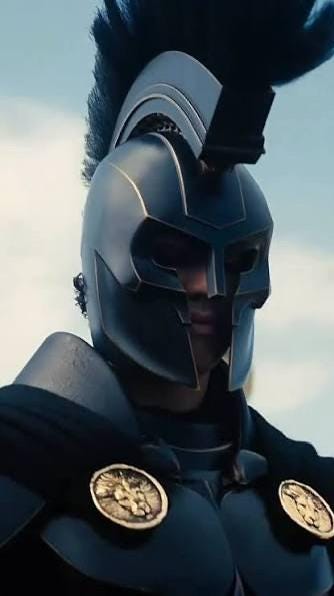
If you would have second thoughts about welcoming this guy into your home, you are not alone.
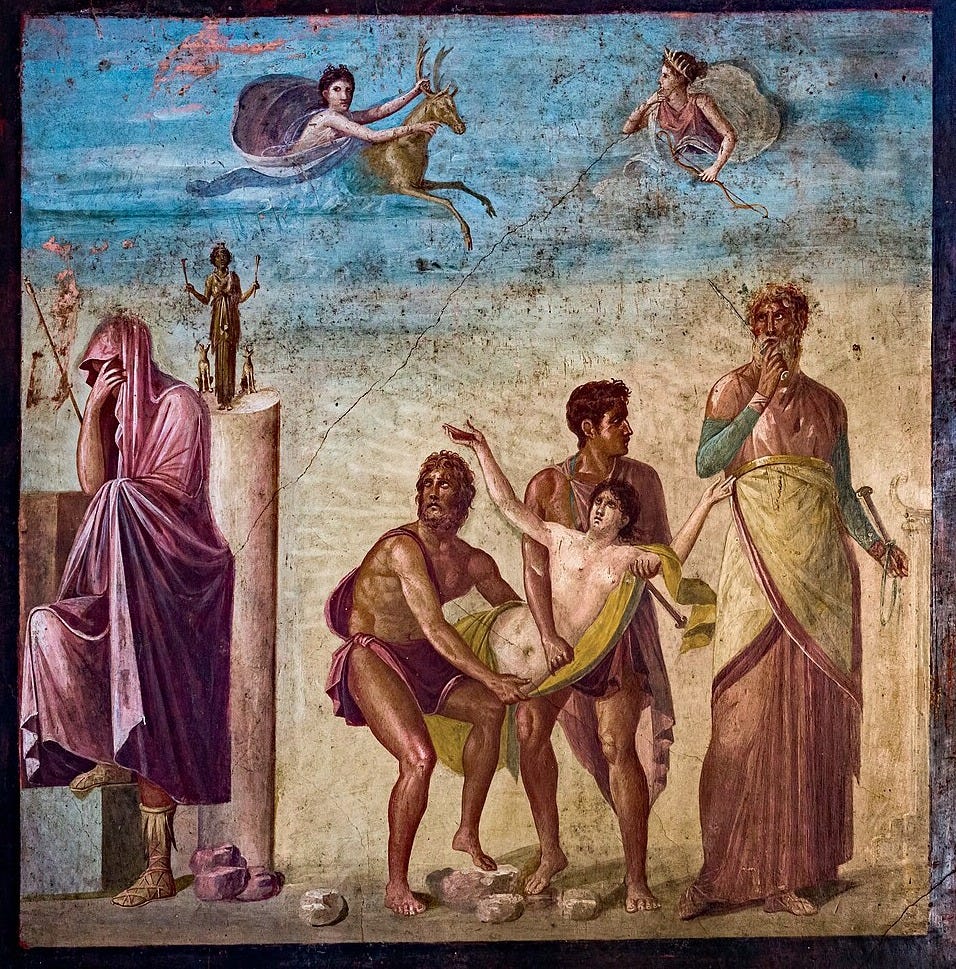
It is what the King did before going to war that ignites the motor of the complex plot of the play. In order to set sail in a dead calm, to join his brother Menelaus in avenging the abduction of Helen, Agamemnon sacrificed his own daughter, by his own hand. Killing her on an altar. In the words of the play, ‘as if a goat.’ I don’t know if it is possible to imagine a worse act. Whether this act is a crime, whether it can have any possible justification, and how to meet it properly is central to the conflicts that unfold across the three plays of the Oresteia.
Clytemnestra, the queen and wife, joins the watchmen and chorus. She feels joy at the return of her husband. But her joy lies in the pleasure she expects to take in killing him. She intends to avenge the death of her beloved daughter.
If it is horrible that Agamemnon took his daughter’s life—and I don’t mind saying that I think it was horrible – he did so because a goddess demanded it. Artemis required the sacrifice to restart the wind, which she had calmed, that could fill the sails of his navy. If he did not set sail, the battle could not be won. The battle was fought to avenge the theft of Helen from Menelaus, Agamemnon’s brother. If Helen could not be retaken, his brother’s honor could not be avenged. This long-chain of inexorably linked circumstances is a hallmark of emergent systems – and of Greek tragedy.
The chain of actions and reactions that led to this act of sacrifice stretched beyond the Trojan War. Agamemnon came from a family with a long and bloody history of violence. His great-great-grandfather, Tantalus, was condemned to the torment of eternal and unquenchable thirst, with water held just out of his reach. This is the origin of the word ‘tantalize.’ It was a punishment for a crime similar to Agamemnon’s, but one that was, or is now, even less comprehensible. To test the omniscience of the gods, Tantalus killed his own son, and served him as a meal on Olympus, to see whether the gods would eat human flesh. Disgusted, the gods condemned Tantalus to eternal punishment—and also showed mercy. They brought his son, Pelops, back to life.
But the act of mercy did not end the violence. Two of Pelops’ sons, Atreus and Thyestes, fell into a bitter feud. Atreus killed Thyestes’ sons and served them to him for dinner. Atreus bore Agamemnon and Menelaus, who were cursed from birth because of their father’s (and great- great- grandfather’s) actions.
This backstory underscores—but does not excuse—the cycle of violence and generational abuse that preceded Iphigenia’s murder.
Clytemnestra had been set on Agamemnon’s death since the sacrifice of Iphigenia and did not hesitate to take a lover to help. That lover was none other than Agamemnon’s cousin, Aegisthus, the only surviving son of Thyestes and bitter enemy of Atreus and his heirs.
Clytemnestra and Aegisthus kill Agamemnon, stabbing him to death over a carpet of deep crimson. Clytemnestra wields the knife. The murder, an act of vengeance, is a classic reversal of circumstance, the king brought low: peripeteia.
These two characters are locked in a conflict created by their situation and the different motivations, goals, and desires they embody. There is another Greek word central to the tragic tradition that can help guide us: Hamartia. For Aristotle, Hamartia is an error made because of inadequate knowledge of circumstance. It is also the cause that leads to peripeteia.
So, one of our guiding questions to understand the value and import of the play should be what kind of circumstances must be known to avoid the tragic reversal of fortune.
The problem is not that the main characters held what would have been considered reprehensible values. The full scope of Clytemnestra’s downfall has not yet been revealed in this first play, but the act of the murder of her husband is unmistakably wrong to the other characters of the play. Nevertheless, her motivations are not wrong.
She is a mother. Anyone who threatens or harms her offspring will suffer from her hand. This is how she protects her children. If she represents a value, it is the value of motherhood and family. A commitment to our offspring, our sons and daughters, or perhaps, in a larger sense, our bloodline, family tree, or kin.
Agamemnon also represents something, though I believe that for modern readers it is a little less clear than Clytemnestra’s motivation. A common interpretation is that Agamemnon represents civic duty and the needs of the state. He is going to war, which is a state action. This lends support to this interpretation. But the war he is going to is based on personal grievances—and represented as such in the play. If there is any refrain to the chorus, it is how awful it was that such small decisions made by so few people— Paris and Helen—led to the mass shedding of blood and the deaths of so many Greeks and Trojans. And the war does not lead to greatness for Mycenae. It more closely resembles a blight, one that ruined the city when it was deserted by all the able warriors, an entire generation of men, for a full decade. And many of those men—husbands, sons, and fathers—never returned to their family or city but instead died in the battlefield or on the treacherous sea journey home.
The specific lines representing Agamemnon’s fateful decision, in Richard Lattimore’s translation, speak of his “faith of battle,” a toughness that led him to “stay the strength of war, waged for a woman,” and “the kings passioned for battle.” These words do not indicate a commitment to governance or civic duty. They speak of militarism, the heroics of the battlefield, a desire for glory, and the defense of challenges to those ideals. Agamemnon is supporting his brother, who is also his brother-in-arms, so there is a fraternal element, which may be interpreted as familial or about loyalty more generally. All of which is also layered within a family history, which given all the crimes against children, a modern reader might interpret as a history of abuse, something we have found in modern research makes future instances of abuse more likely.
If we as modern readers might be more skeptical of the value of militarism than ancient Greeks, it is also true that Agamemnon is humble on his return, while Clytemnestra is spiteful. Neither is meant to be entirely in the right. And Aeschylus did not mean for the audience to think that either was completely in the wrong. Instead, we have a conflict between two people triggered by very specific social and political entanglements that caused these individuals to make reasoned decisions based on their own values that perpetuates and escalates a cycle of violence.
If moment of reversal is not dependent upon the choice of wrong values, which would be the domain of ethics, philosophy, or possibly education. Perhaps social science can help us to understand which circumstances went ignored and where things subsequently began to go wrong.
Let us begin with the existence of intergenerational effects, a.k.a. the curse of the Atreides.
